




















Your Closet Isn’t Too Small. It’s Just Full
Why Buying More Bins Never Solves A Storage Problem
Let’s talk about your closet. You know the one. The door barely shuts, something is always threatening to fall on your head, and you’ve started saying things like “I just need more storage.” So you do what any reasonable person would do: you open a new tab and start shopping for bins.
Here’s what we tell clients all the time, and it usually gets a surprised laugh: that closet probably isn’t too small. It’s full. Those are two very different problems, and only one of them gets fixed with a trip to the store.
Every Space Has a Limit
Every closet, pantry, and garage can only hold so much before it stops working. Not before it’s physically jammed, before it stops working.
Past that point, things don’t just get crowded. They get harder to reach, easier to lose, and way more annoying to put away. And that last one matters most, because when putting something away is annoying, it ends up on the floor instead.
Here’s the part we find fascinating: that limit isn’t one fixed number, and it isn’t the same for every space. A hall closet you open ten times a day has a much lower capacity than a storage closet you open twice a year, even if they’re exactly the same size. The more often you reach for things, the more breathing room a space needs to stay easy to use. It’s why your entryway and kitchen drawers fill up so fast: they’re your busiest spaces, which means they have the least room to spare.
Why Bins Don’t Fix It
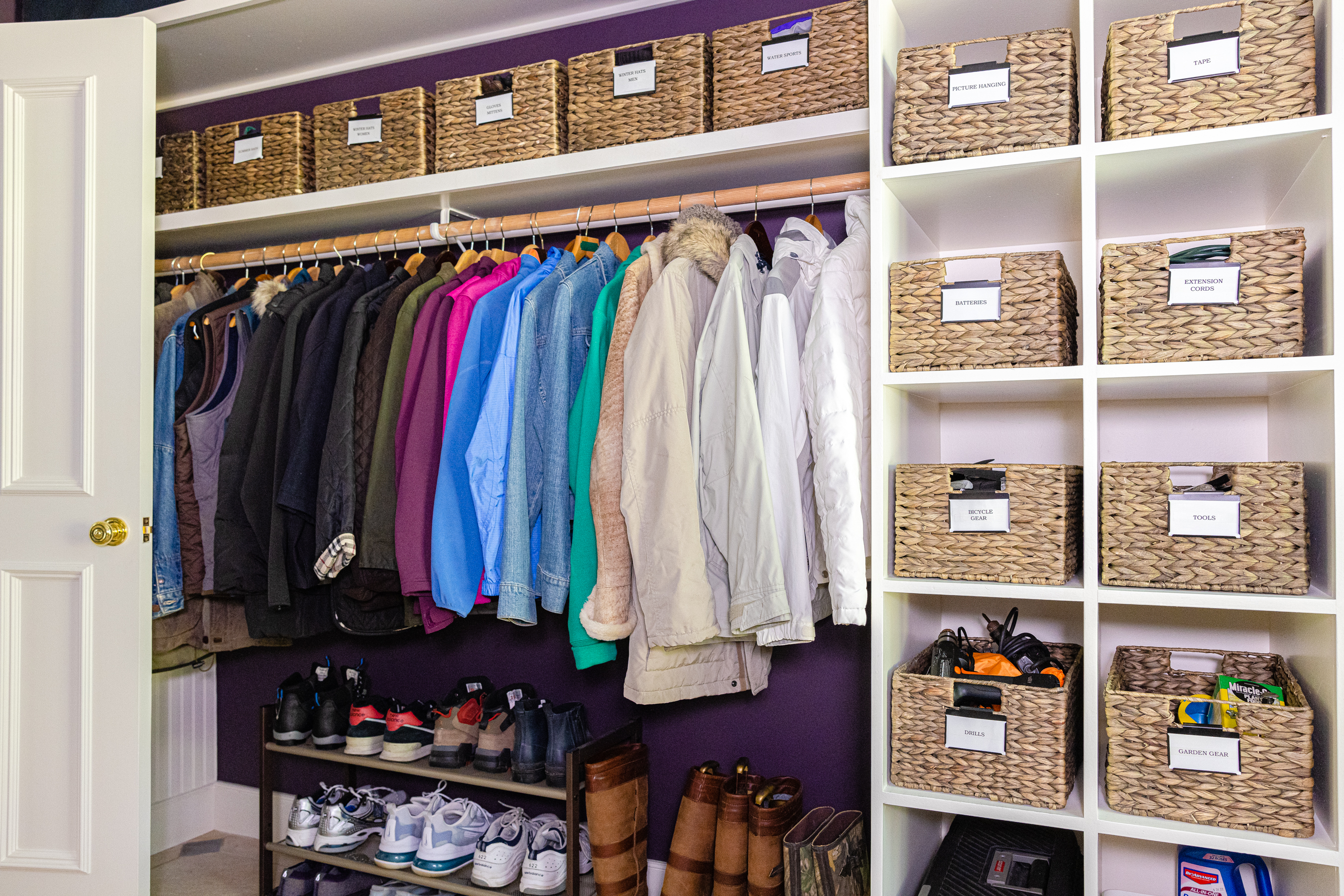
Bins feel like the answer because they make a full space look calm. But a bin doesn’t create room. It just rearranges what’s already there, and it takes up some space of its own. You’ve made the shelf look like it holds more without changing how much it can actually hold.
Then a couple of months go by, the shelf is full again, and now you also own a lot of bins. Sound familiar? You’re not bad at this. It’s just that nobody ever tells you that a space has a real limit, so it feels like you’re failing when you hit it.
How to Find Your Space’s Real Limits
You don’t need a tape measure or a spreadsheet. A few quick checks will tell you where a space tops out:
- The one-hand test. Can you grab what you need without moving something else first? If getting the thing in the back means unstacking three things in the front, that shelf is past its limit.
- The breathing room check. A shelf that’s jammed edge to edge is over capacity, even if everything fits. Leave a visible gap so you can slide things in and out without a wrestling match.
- The overflow clue. Look at what’s piling up on the closet floor or on top of the bins. That overflow is your space telling you it’s maxed out, and it’s usually a pretty accurate alarm.
- The “what is this space for” question. A pantry that’s supposed to hold weeknight dinner ingredients but is also home to a bread maker, holiday platters, and bulk paper towels is being asked to do three jobs. Decide the main job, and let the rest find a different home.
Think of It Like a Budget
The easiest way to make this stick is to treat your space like a budget. If you’re overspending, you don’t fix it with a bigger wallet. You look at what’s coming in and decide what’s worth the money.
Same idea here. A shelf can hold what it can hold. When something new comes in, something else needs to go, move, or earn its spot. It’s not about being strict or minimal. It’s just knowing what you’re working with, so you stop being surprised every time the closet “mysteriously” fills up again.
Once you know the real limit, the whole thing gets easier. You can buy a bin because you have a real reason to, not because you’re hoping it will magically make more room.
A full closet isn’t a sign you did something wrong. It’s just a sign you’ve hit the limit, and now you know what to do about it.
Not sure where your closet’s real limit is? DDH can help you find it and set things up so your space actually works.Contact us today!
| Knowing a Space’s Limits Is Half the Job Figuring out what a space can realistically hold, and what belongs somewhere else, is at the heart of every DDH project. It’s also exactly what we train every franchisee to do as DDH grows into new markets. As a DDH franchisee, you step into a proven playbook, hiring systems, and brand support from day one, so you can help families in your own community stop fighting their storage and start using it.Learn more about franchise opportunities with DDH. Click the link below. |
