




















When Matching Bins Stop Working
Why The Prettiest System in Your Home is the One Nobody Uses
You’ve done the work. The closet is edited, the drawers are labeled, and everything lives in a matching set of bins that looks like it belongs in a catalog. And yet, three months later, things aren’t going back where they belong. The system that looked perfect on installation day is quietly falling apart — and it’s not because anyone got lazy.
It’s because uniformity and function are two different goals, and sometimes they’re pulling in opposite directions.
The Aesthetic Trap
Matching bins solve a real problem: visual chaos. A shelf of identical white containers looks calmer than a shelf of mismatched shoeboxes and grocery bags. But “calmer to look at” and “easier to use” are not the same thing, and a lot of organizing advice treats them as interchangeable.
The uniformity that makes a pantry look good in a photo can be the exact thing that makes it harder to live with. Here’s where that shows up in real households:
The Lid Problem
A family organizes the kids’ art supplies into a stack of identical lidded bins. It looks tidy — until you watch what actually happens at 4pm on a Tuesday. A kid wants markers, which are in the third bin down, so all four bins get pulled off the shelf and only one goes back on straight. A system that requires removing and replacing a lid, every single time, for a five-year-old, isn’t a five-year-old’s system. An open bin or a shallow tray with no lid would get used correctly ten times more often.
The Shape Mismatch
A linen closet gets a beautiful set of matching rectangular bins, sized to fit the shelf perfectly — except the actual items being stored are odd shapes: a bulky heating pad, a tangle of extra cords, a rolled-up yoga mat. Everything gets crammed in sideways to make the bin lid close, which means every future search involves partially unpacking the bin to find anything. The container dictated the system instead of the items dictating the container, and that’s backwards.
The Identical-label Problem
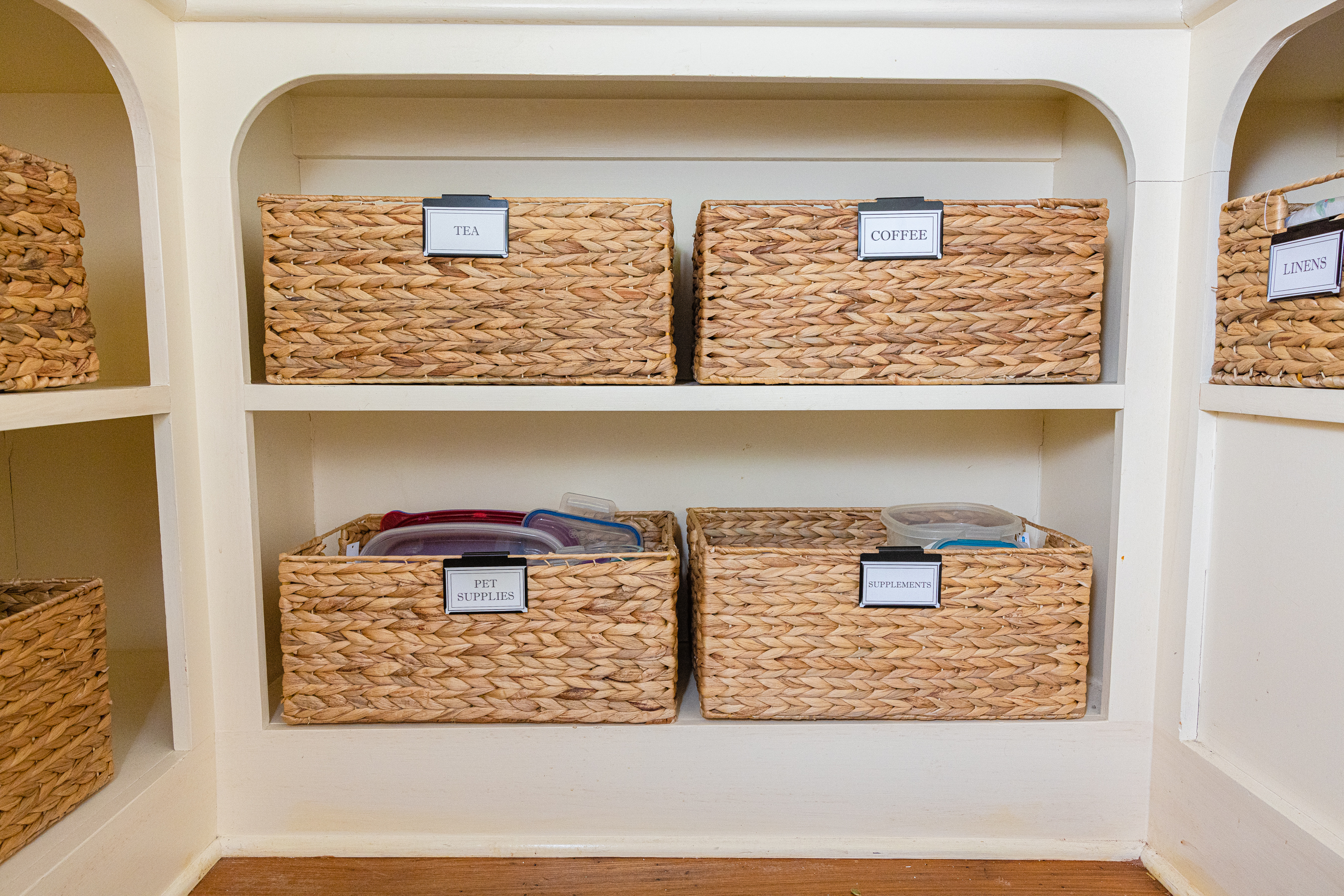
A pantry gets a full wall of matching bins with matching label fonts — gorgeous, but nearly impossible to scan quickly. When every container is the same size, shape, and color, your eye has nothing to differentiate on except tiny text, which means finding the pasta actually takes longer than it did with the mismatched grocery-store packaging. Varying size or color by category (even subtly) often outperforms pure uniformity for speed of use.
The One-size Household Problem
A garage gets organized with a single style of bin for every family member’s gear — practical for the parent who set it up, but the teenager who needs to grab cleats before practice doesn’t have the same visual shorthand. Different people in the same household often need different cues (color-coding by person, open bins vs. closed, floor-level vs. shelf) to actually maintain a shared system. One elegant solution designed around one person’s brain doesn’t always transfer to everyone using it.
Function First, Then Form
None of this means matching bins are wrong. Sometimes uniformity is exactly right — a closet no one touches daily, a storage room, an archive of seasonal decor. The problem isn’t bins that match. It’s choosing the aesthetic before asking how the space actually gets used, by whom, how often, and under what conditions (rushed mornings, a five-year-old’s motor skills, a garage shared by three different schedules).
The households where organizing actually sticks are the ones where the container was chosen last, after the real behavior of the space was understood — not first, because it photographed well.
If your beautifully organized space keeps drifting back into chaos, it might not be a discipline problem. It might be a design problem — and that’s a different fix.
Curious whether your system is working against you? DDH can take a look and help you figure out what’s actually going on. Contact us today to get a team into your home to evaluate your situation.
| This Kind of Diagnosis Is a Trained Skill Knowing when a matching set of bins will actually get used and when it will quietly work against a household isn’t guesswork. It’s a skill DDH organizers are trained to apply on every job, which is exactly what we bring to every market we expand into through franchising. As a DDH franchisee, you’re not guessing at what makes a system stick, you’re trained on the same function-first framework behind every DDH project, backed by a proven playbook, hiring systems, and brand support from day one. Learn more about franchise opportunities with DDH – Click on the link below. |
